Probability Calculator Calculate simple probability, union, intersection, conditional probability, and complement.


Probability Calculator
Calculate simple probability, union, intersection, conditional probability, and complement.
Choose Mode
Select from simple probability, union, intersection, conditional, or complement.
Enter Values
Input the required probability values or favorable/total outcomes.
Get Result
View the calculated probability as a decimal, percentage, and formula.
What Is Probability Calculator?
A probability calculator helps you compute the likelihood of events occurring. This tool supports five calculation modes: (1) Simple probability — P(A) = favorable outcomes / total outcomes. (2) Union — P(A∪B) = P(A) + P(B) − P(A∩B), the probability that either event occurs. (3) Intersection — P(A∩B), the probability that both events occur simultaneously. (4) Conditional — P(A|B) = P(A∩B) / P(B), the probability of A given that B has occurred. (5) Complement — P(A') = 1 − P(A), the probability that A does NOT occur. Probability theory is the mathematical foundation of statistics, risk analysis, machine learning, genetics, insurance, gambling, and decision-making. Understanding these fundamental operations is essential for anyone working with uncertain events or data-driven decisions.
Why Use Probability Calculator?
-
Five calculation modes covering all fundamental probability operations
-
Shows formulas alongside results for learning
-
Handles both independent and dependent events
-
Displays results as decimal, percentage, and odds
-
Clear input labels guide you through each calculation type
Common Use Cases
Statistics Courses
Solve probability homework involving unions, intersections, and conditional probability.
Risk Assessment
Calculate the likelihood of combined events for business risk analysis.
Games & Gambling
Compute odds of specific outcomes in dice, cards, or lottery scenarios.
Quality Control
Determine defect probabilities and combined failure rates.
Technical Guide
Probability is a real number between 0 (impossible) and 1 (certain). The addition rule for union is P(A∪B) = P(A) + P(B) − P(A∩B), where the subtraction prevents double-counting the intersection. For independent events (where A doesn't affect B), P(A∩B) = P(A) × P(B). For dependent events, P(A∩B) = P(A|B) × P(B). Conditional probability, derived from Bayes' theorem, is P(A|B) = P(A∩B) / P(B), provided P(B) > 0. The complement rule states P(A') = 1 − P(A), which is useful when calculating "at least one" probabilities via P(at least one) = 1 − P(none). The calculator accepts probabilities between 0 and 1, validates that combined probabilities don't exceed bounds, and for simple probability mode, computes the ratio of favorable to total outcomes. All results are shown with up to 6 decimal places and as a percentage.
Tips & Best Practices
-
1Probabilities must be between 0 and 1 (or 0% to 100%)
-
2For "at least one" problems, use 1 − P(none)
-
3Independent events: P(A∩B) = P(A) × P(B)
-
4For dependent events, you must specify P(A∩B) explicitly
-
5The complement is useful: P(A) = 1 − P(not A)
Related Tools

Standard Deviation Calculator
Calculate population or sample standard deviation, variance, mean, and range of a dataset.
🔢 Math & Calculators
Permutation Calculator (nPr)
Calculate the number of permutations (ordered arrangements) of n items taken r at a time.
🔢 Math & Calculators
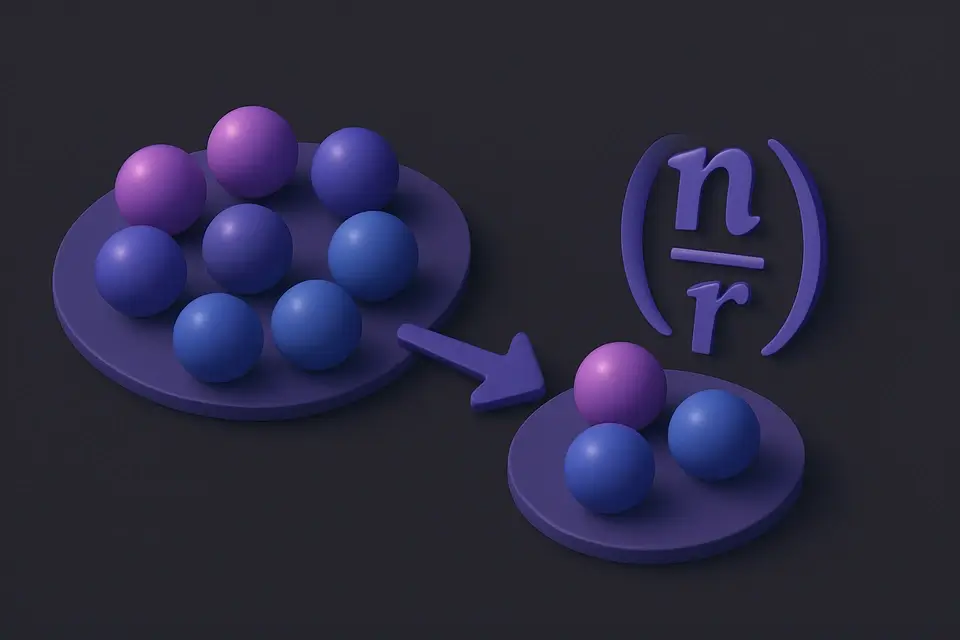
Combination Calculator (nCr)
Calculate combinations (unordered selections) with or without repetition.
🔢 Math & Calculators

Percentage Calculator
Calculate percentages, percentage change, and what percent one number is of another.
🔢 Math & CalculatorsFrequently Asked Questions
Q What is the difference between independent and dependent events?
Q What is conditional probability?
Q Can two probabilities add up to more than 1?
Q What are odds vs probability?
Q How do I handle "or" vs "and" in probability?
About This Tool
Probability Calculator is a free online tool by FreeToolkit.ai. All processing happens directly in your browser — your data never leaves your device. No registration or installation required.