Quadratic Equation Solver Solve quadratic equations (ax² + bx + c = 0) and find roots, discriminant, and vertex.

Quadratic Equation Solver
Solve quadratic equations (ax² + bx + c = 0) and find roots, discriminant, and vertex.
Enter Coefficients
Input the values for a (x² coefficient), b (x coefficient), and c (constant term).
View the Solution
See the roots (real or complex), discriminant value, and type of roots.
Check Vertex
View the vertex coordinates of the parabola defined by your equation.
What Is Quadratic Equation Solver?
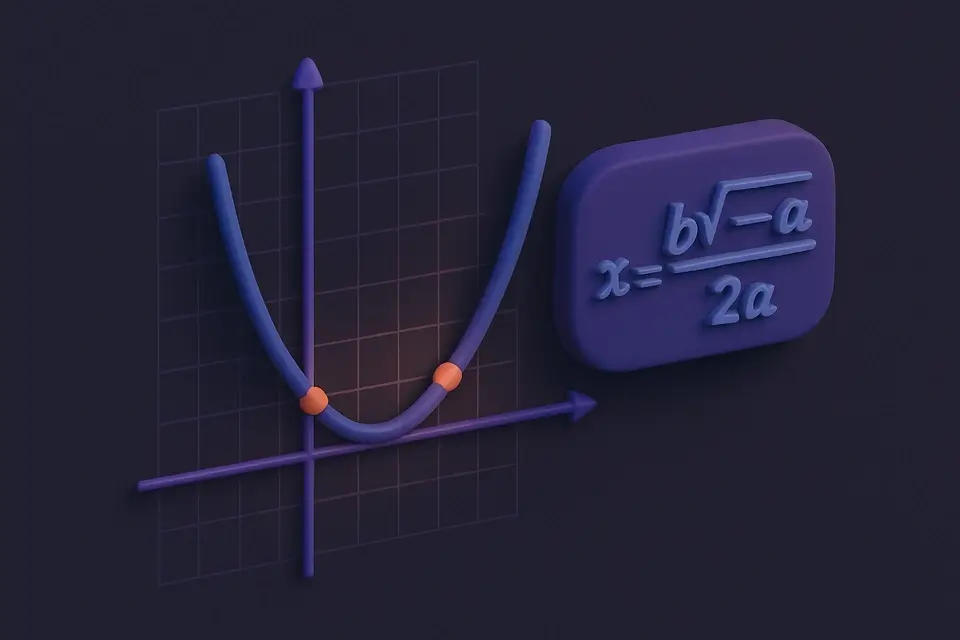
The quadratic equation solver finds the roots (solutions) of any equation in the form ax² + bx + c = 0 using the quadratic formula: x = (−b ± √(b²−4ac)) / 2a. The discriminant (b²−4ac) determines the nature of the solutions: when positive, there are two distinct real roots; when zero, there is one repeated real root; when negative, there are two complex conjugate roots involving imaginary numbers. Beyond finding roots, the solver also computes the vertex of the parabola y = ax² + bx + c, located at (−b/2a, c − b²/4a), which represents either the minimum or maximum point of the curve. Quadratic equations appear in physics (projectile motion), engineering (structural analysis), economics (profit optimization), and geometry (area problems). This tool handles all cases including complex roots, negative coefficients, and fractional values, displaying results with clear formatting and the applied formula.
Why Use Quadratic Equation Solver?
-
Solves any quadratic equation with real or complex roots
-
Shows discriminant to understand the nature of solutions
-
Computes vertex for parabola graphing
-
Displays the quadratic formula application step by step
-
Handles edge cases like complex conjugate roots cleanly
Common Use Cases
Algebra Homework
Quickly solve and verify quadratic equation problems from math class.
Physics Problems
Solve projectile motion equations where height or position is quadratic in time.
Optimization
Find the maximum or minimum of a quadratic function by locating the vertex.
Engineering Design
Solve quadratic relationships in circuit analysis, structural loads, and signal processing.
Technical Guide
The quadratic formula x = (−b ± √(b²−4ac)) / 2a is derived by completing the square on the general quadratic equation. The discriminant Δ = b²−4ac determines root type: Δ > 0 gives two distinct real roots, Δ = 0 gives one repeated root (the parabola touches the x-axis), and Δ < 0 gives complex conjugate roots of the form (−b/2a) ± (√|Δ|/2a)i. The vertex form of a parabola is y = a(x−h)² + k where h = −b/2a and k = c − b²/4a. When a > 0 the parabola opens upward (vertex is minimum); when a < 0 it opens downward (vertex is maximum). For numerical stability, the solver uses the standard formula directly since JavaScript's double-precision arithmetic provides sufficient precision for typical educational and engineering values. The coefficient a must be non-zero for the equation to be quadratic; when a = 0, the equation becomes linear (bx + c = 0) and the tool reports this condition. Results display up to 6 decimal places for precision while maintaining readability.
Tips & Best Practices
-
1The discriminant tells you everything about the roots before you even calculate them
-
2If a = 0, the equation is linear, not quadratic — use simple algebra instead
-
3The vertex is always at x = −b/(2a) regardless of whether the roots are real or complex
-
4For projectile motion, the vertex gives the maximum height and the time to reach it
-
5Complex roots always come in conjugate pairs: if a+bi is a root, so is a−bi
Related Tools


Scientific Calculator
Full-featured scientific calculator with trigonometry, logarithms, factorials, and more.
🔢 Math & Calculators

Matrix Calculator
Perform matrix operations: add, multiply, find determinant, inverse, and transpose for 2×2 and 3×3 matrices.
🔢 Math & Calculators
Exponent Calculator
Calculate x raised to the power of n (xⁿ) with scientific notation output.
🔢 Math & Calculators

Weighted Average Calculator
Calculate weighted averages with dynamic data entry, showing both weighted and simple averages.
🔢 Math & CalculatorsFrequently Asked Questions
Q What is the quadratic formula?
Q What does the discriminant tell me?
Q What are complex roots?
Q Can a equal zero?
Q What is the vertex of a parabola?
About This Tool
Quadratic Equation Solver is a free online tool by FreeToolkit.ai. All processing happens directly in your browser — your data never leaves your device. No registration or installation required.