Number Base Converter Convert numbers between any bases from 2 to 36, including binary, octal, decimal, and hex.
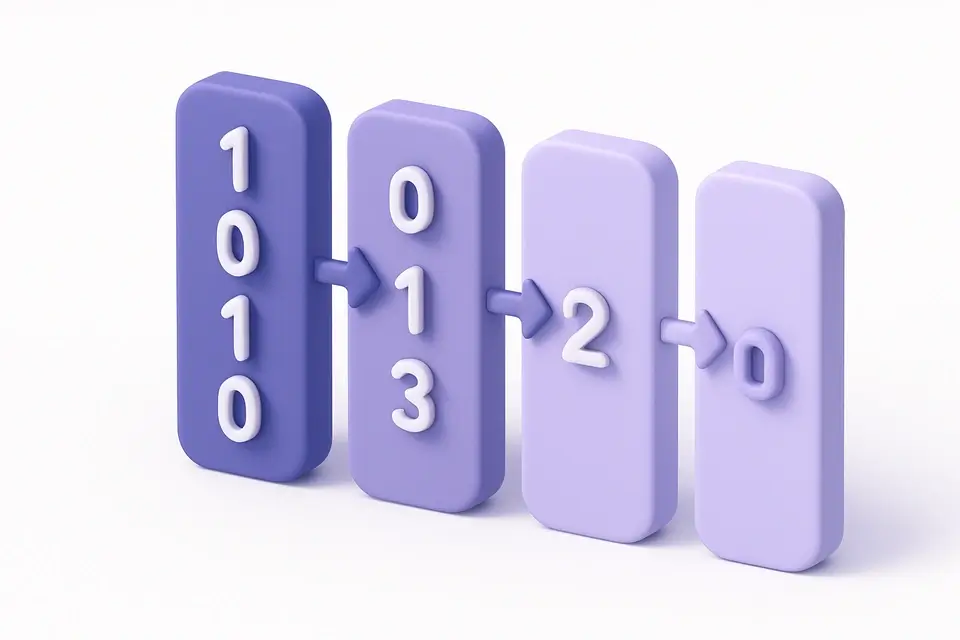
Number Base Converter
Convert numbers between any bases from 2 to 36, including binary, octal, decimal, and hex.
Enter a Number
Type the number you want to convert.
Set Source Base
Select or type the base of your input number (2 to 36).
Choose Target Base
Select the base to convert to and view all common conversions.
What Is Number Base Converter?
The number base converter transforms numbers between different positional numeral systems (radixes). While we typically use base-10 (decimal) in everyday life, computers use base-2 (binary), and programmers frequently work with base-8 (octal) and base-16 (hexadecimal). This tool supports conversion between any base from 2 to 36, where bases above 10 use letters A-Z as additional digits. Common conversions include binary ↔ decimal (essential for understanding digital logic), decimal ↔ hex (used in programming and web colors), and any custom base for specialized applications like base-36 encoding (which uses all alphanumeric characters). The converter shows the result in all four common bases (binary, octal, decimal, hex) simultaneously, making it a one-stop tool for number system work.
Why Use Number Base Converter?
-
Converts between any base from 2 to 36
-
Preset buttons for common bases (2, 8, 10, 16)
-
Shows all four common bases simultaneously
-
Validates input characters against the selected base
-
Custom base input for specialized applications
Common Use Cases
Programming
Convert between binary, hex, and decimal for debugging and code development.
Computer Science Education
Learn and practice number base conversions for CS courses.
Data Encoding
Work with base-32, base-36, or other encoding systems.
Digital Electronics
Convert between binary and other representations for circuit design.
Technical Guide
Number base conversion works in two steps: (1) Convert the input to an intermediate decimal (base-10) representation by computing Σ(dᵢ × base^i) where dᵢ is the digit at position i. (2) Convert from decimal to the target base by repeatedly dividing by the target base and collecting remainders. For bases above 10, digits beyond 9 are represented as A=10, B=11, ..., Z=35, supporting up to base-36. The converter validates that each character in the input is a valid digit for the specified base. JavaScript's parseInt(value, radix) handles the first step, while toString(radix) handles the second. Both support radixes from 2 to 36 natively. The converter works with positive integers; negative numbers are handled by converting the absolute value and preserving the sign.
Tips & Best Practices
-
1Binary (2), octal (8), and hex (16) are all powers of 2, making conversions between them straightforward
-
2Each hex digit = 4 binary bits; each octal digit = 3 binary bits
-
3Base-36 uses all digits (0-9) and letters (A-Z) — useful for compact encoding
-
4Invalid characters for the selected base will produce an error
-
5The maximum supported base is 36 (0-9 plus A-Z)
Related Tools
Binary Calculator
Perform binary arithmetic and bitwise operations (AND, OR, XOR, NOT).
🔢 Math & Calculators
Hexadecimal Calculator
Perform hexadecimal arithmetic and bitwise operations with multi-base output.
🔢 Math & Calculators
Octal Calculator
Perform octal (base-8) arithmetic with decimal, binary, and hex conversions.
🔢 Math & Calculators
Factorial Calculator
Calculate the factorial of any number (n!) with digit count and expansion.
🔢 Math & CalculatorsFrequently Asked Questions
Q How do I convert binary to decimal?
Q What bases does this support?
Q What is base-36 used for?
Q Why are bases 2, 8, and 16 common in computing?
Q Can I convert decimal fractions?
About This Tool
Number Base Converter is a free online tool by FreeToolkit.ai. All processing happens directly in your browser — your data never leaves your device. No registration or installation required.