String Escape/Unescape Escape or unescape special characters in strings (newlines, tabs, quotes).
String Escape/Unescape
Escape or unescape special characters in strings (newlines, tabs, quotes).
Paste Your String
Paste text with special characters or escaped sequences.
Select Escape or Unescape
Select Escape or Unescape mode.
Copy the Processed Output
Copy the processed string.
What Is String Escape/Unescape?
A String Escape/Unescape is a process that converts between literal special characters and their escape sequence representations, allowing developers to work with strings in programming languages. Developers who need to prepare text for code insertion or read escaped string content use it to solve the problem of handling special characters like newlines, tabs, and quotes. For instance, when working with JSON data, escaping special characters is crucial to prevent syntax errors.
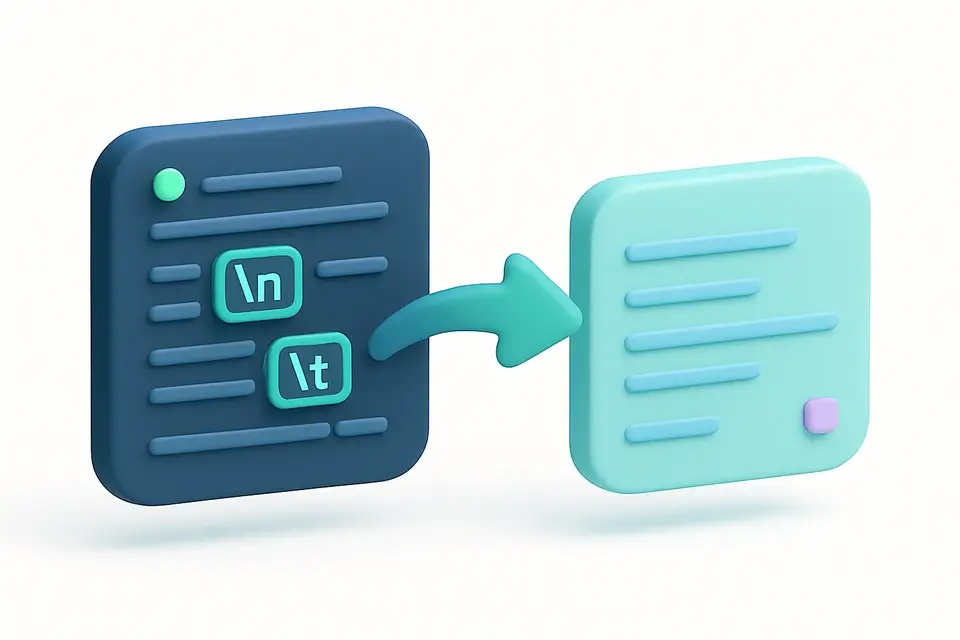
The tool's escape mode replaces special characters with their corresponding escape sequences, such as converting newlines to \n, tabs to \t, backslashes to \\, and quotes to \" or \'. This is particularly useful for how to escape newlines in strings. In unescape mode, it converts these escape sequences back to their literal characters, enabling developers to convert escape sequences to text.
What makes this tool different is its ability to switch between escape and unescape modes using radio buttons, allowing users to easily toggle between the two functions. It also uses regular expressions to replace special characters with their escape sequences, ensuring accurate results. For example, it replaces \0 with \\0 and \\ with \\\\ when escaping, and reverses these operations when unescaping, making it a useful resource for escape special characters online.
Why Use String Escape/Unescape?
-
Prepare text for embedding in source code strings
-
Convert escaped sequences back to readable text
-
Debug strings with invisible special characters
-
Handle escape sequences in configuration files
Common Use Cases
Programming
Escape text content for insertion into string literals in code.
Debugging
Unescape string values from logs or debugger output.
Configuration
Escape or unescape values in configuration files.
Data Processing
Convert between escaped and literal representations of text.
Technical Guide
The escape function applies a series of string replacements in a specific order. Backslashes are escaped first (to \\) to prevent double-processing. Then newlines (\n), carriage returns (\r), tabs (\t), double quotes (\"), single quotes (\'"), and null bytes (\0) are escaped. The unescape function applies replacements in a different order: literal escape sequences (\n, \r, \t, etc.) are converted to their character equivalents, with backslash escapes (\\) processed last to prevent false matches. This order-dependent processing ensures correct results even with strings containing multiple types of special characters.
Tips & Best Practices
-
1Escape mode processes backslashes first to prevent double-escaping
-
2Unescape handles standard C-style escape sequences
-
3Escape text before inserting into code to avoid syntax errors from unescaped quotes or newlines
-
4Different from JSON escaping — this does not add surrounding quotes
Related Tools


URL Encoder
Encode text for safe use in URLs with percent-encoding.
📝 Text Tools

HTML Entity Encoder
Encode special characters as HTML entities for safe HTML insertion.
📝 Text Tools

JSON Escape/Unescape
Escape text for JSON strings or unescape JSON string values.
📝 Text Tools

Whitespace Visualizer
Make invisible whitespace characters visible with symbolic markers.
📝 Text ToolsFrequently Asked Questions
Q How is this different from JSON escape?
Q Which escape sequences are supported?
Q Does the order of processing matter?
Q Can I escape text for a specific programming language?
Q Does it handle Unicode escape sequences?
About This Tool
String Escape/Unescape is a free online tool by FreeToolkit.ai. All processing happens directly in your browser — your data never leaves your device. No registration or installation required.