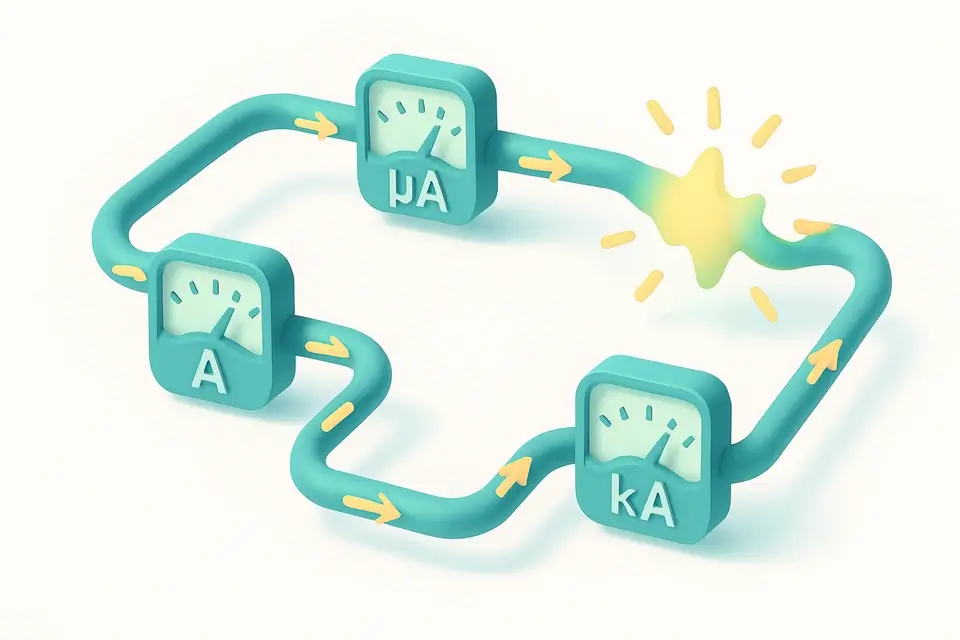
Convert Between Electric Current Units Convert between amperes, milliamperes, microamperes, and kiloamperes.

Electric Current Converter
Convert between amperes, milliamperes, microamperes, and kiloamperes.
Enter Current Value
Type the electric current value.
Select Units
Choose source and target current units.
View the Converted Current
Converted current appears instantly.
What Is Electric Current Converter?
An electric current converter translates between different scales of the ampere, the SI base unit of electric current. Electrical engineers and technicians use it to solve problems like converting amps to milliamps or microamps to amps in circuit designs. For instance, when working with small electronic circuits that require precise current measurements in milliamps, but the available data is in amps, the tool helps convert mA to A accurately.
It supports conversions between four electric current units: Ampere (A), Milliampere (mA), Microampere (µA), and Kiloampere (kA), with conversion factors defined for each unit. The default settings allow users to easily switch from amps to milliamps, which is a common requirement in electronics design. What makes this tool different is its reference configuration, which includes predefined conversions like amps to microamps or kiloamps to milliamps, allowing for quick and accurate calculations.
The conversion process relies on a set of predefined references that define the relationships between units, such as 1 amp being equal to 1000 milliamps. These references enable precise conversions and help users understand how to convert amps to milliamps or perform other electric current unit conversions accurately. With its ability to handle various electric current units and conversion scenarios, it becomes a useful aid in troubleshooting electronics and designing safe electrical circuits.
Why Use Electric Current Converter?
-
Covers the full range from microamperes to kiloamperes.
-
Essential for electronics and electrical engineering.
-
Simple, fast conversion.
-
Real-time bidirectional input.
Common Use Cases
Electronics
Convert between mA and µA for sensor readings and circuit design.
Electrical Engineering
Power system specs often require switching between A and kA.
Battery Life
Battery capacity calculations need mA-to-A conversions (mAh to Ah).
Safety
Understand current magnitudes for electrical safety assessments.
Technical Guide
Since 2019, the ampere (A) has been defined by fixing the elementary charge e = 1.602176634 × 10⁻¹⁹ coulombs.
• 1 kA = 1,000 A
• 1 A = 1,000 mA
• 1 mA = 1,000 µA
Typical currents:
• Smartphone standby: ~5-50 mA
• USB charging: 500 mA (USB 2.0) to 3 A (USB-C PD)
• Household circuit breaker: 15-20 A
• Car starter motor: 100-300 A
• Lightning bolt: ~20-200 kA (peak)
Safety: As little as 10 mA of current through the heart can be fatal. Household voltages can easily drive lethal currents through the body.
Tips & Best Practices
-
11 A = 1,000 mA = 1,000,000 µA. Simple decimal shifts.
-
2Dangerous current: as little as 10 mA across the heart can be lethal.
-
3Battery capacity: a 5,000 mAh battery can deliver 5 A for 1 hour (theoretically).
-
4USB-C Power Delivery can provide up to 5 A at 20V (100W).
Related Tools
Power Converter
Convert between watts, kilowatts, megawatts, horsepower, PS, BTU/h, and ft-lbf/s.
⚖️ Unit Converters

Voltage Converter
Convert between volts, millivolts, microvolts, kilovolts, and megavolts.
⚖️ Unit Converters
Capacitance Converter
Convert between farads, millifarads, microfarads, nanofarads, and picofarads.
⚖️ Unit Converters
Inductance Converter
Convert between henries, millihenries, microhenries, and nanohenries.
⚖️ Unit ConvertersFrequently Asked Questions
Q How many milliamps in an amp?
Q What is a dangerous level of current?
Q What current does a typical USB port provide?
Q What is a kiloampere used for?
About This Tool
Electric Current Converter is a free online tool by FreeToolkit.ai. All processing happens directly in your browser — your data never leaves your device. No registration or installation required.