Text to ASCII Art Convert text to large ASCII art letters using the Standard font.
Text to ASCII Art
Convert text to large ASCII art letters using the Standard font.
Enter Text
Type the text you want to convert to ASCII art.
View ASCII Art
See your text rendered as large ASCII art characters.
Copy the ASCII Art
Copy the ASCII art for use in code comments, READMEs, or terminal output.
What Is Text to ASCII Art?
A Text to ASCII Art is a tool that converts input text into large, eye-catching ASCII art characters using the classic FIGlet font. Developers and designers use it to create visually appealing text banners for terminal displays, code comments, README files, and retro-styled text displays. One specific problem it solves is generating readable and stylized text for console outputs or plain-text environments where images are not supported.
It uses the figlet library, specifically the "Standard" font, to generate ASCII art from input text. This tool is different because it allows users to convert text to ASCII art online with a simple interface, without requiring knowledge of FIGlet commands or options. The figlet.textSync function is used to parse the input text and generate the corresponding ASCII art, which is then displayed as output.
The tool's implementation includes error handling, catching any exceptions that occur during the generation process and displaying an error message if the input text is too long. It also uses a specific font, "Standard", which is registered using figlet.parseFont, to ensure consistent output. This ASCII art generator can be used to create ASCII banners, convert text to ASCII art online, or generate ASCII text banners for various purposes, making it a useful utility for those who need to create stylized text displays.
Why Use Text to ASCII Art?
-
Classic FIGlet Standard font rendering
-
Perfect for terminal banners and headers
-
Great for README files and documentation
-
Copy-pasteable ASCII art output
-
Nostalgic retro computing aesthetic
Common Use Cases
Terminal Banners
Create startup banners for CLI applications and scripts.
Code Comments
Add section headers in source code using ASCII art dividers.
README Files
Generate project name headers for GitHub README files.
Email Signatures
Add retro-styled text art to plain text email signatures.
Technical Guide
The tool's underlying implementation relies on the figlet library, a JavaScript port of the FIGlet C program, which defines each character as a multi-line pattern using standard ASCII characters. In the case of the Standard font, each character is rendered across 6 rows of text, with the library compositing these patterns side by side to form the final ASCII art output. This process involves handling kerning, or character spacing, and smushing, which allows for overlapping adjacent characters to produce tighter output. The conversion itself is synchronous, running entirely in the browser using React's useState and useCallback hooks to manage state and optimize performance.
When a user inputs text, it is passed to the figlet.textSync function, which parses the input string and generates the corresponding ASCII art based on the registered font, in this case, Standard. The tool uses the 'use client' directive, indicating that it is a client-side React application, and imports necessary components from react and figlet libraries. Error handling is also implemented using a try-catch block to catch any exceptions that occur during the generation process, returning an error message if the input text is too long or if there is an issue with generating the ASCII art.
The TextToAsciiArt function utilizes React's useCallback hook to memoize the onProcess function, which is called whenever the user inputs new text. This optimization helps reduce unnecessary re-renders and improves overall performance. The tool also uses a specific font, Standard, which is registered using figlet.parseFont, ensuring consistent output across different input texts. Additionally, the library's ability to handle smushing and kerning allows for more control over the final ASCII art output, enabling users to generate stylized text displays that meet their needs.
The figlet library itself relies on a data structure of predefined font patterns to generate the ASCII art, with each character represented as a series of ASCII characters arranged in a specific pattern. This approach enables efficient generation of complex ASCII art outputs from simple input texts, making it an ideal choice for applications where stylized text displays are required. The tool's use of this library and its implementation details demonstrate a clear understanding of the underlying technologies and algorithms involved in generating ASCII art from text inputs.
Tips & Best Practices
-
1Keep text short — ASCII art gets very wide with long strings
-
2Use monospace fonts to display ASCII art correctly
-
3Works best with ASCII characters (A-Z, 0-9)
-
4For multiple font options, use the ASCII Art Generator tool instead
-
5ASCII art may not display correctly in proportional fonts
Related Tools

Uppercase Converter
Convert text to UPPERCASE letters instantly.
📝 Text Tools

Text Reverser
Reverse any text character by character.
📝 Text Tools
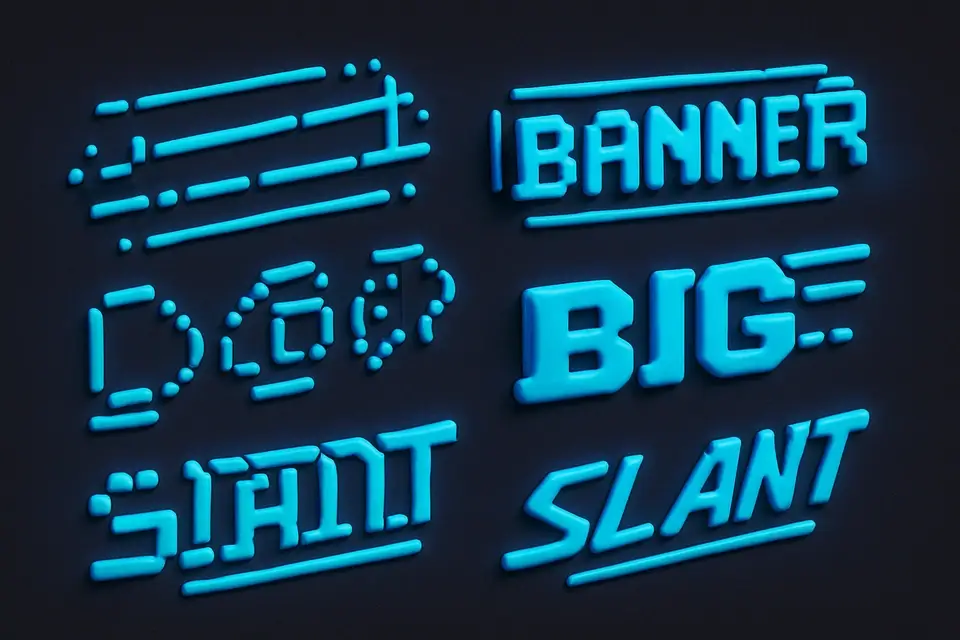
ASCII Art Generator
Generate ASCII art text with multiple font styles — Standard, Banner, Doom, Big, Slant.
📝 Text Tools

Fancy Text Generator
Apply fancy text styles — strikethrough, underline, fullwidth, small caps, and more.
📝 Text Tools

Unicode Text Generator
Convert text to Unicode styled variants — bold, italic, script, fraktur, and more.
📝 Text ToolsFrequently Asked Questions
Q What font does this ASCII art generator use?
Q Why does the output look wrong in my editor?
Q Is there a character limit?
Q Can I use special characters?
Q What is FIGlet?
About This Tool
Text to ASCII Art is a free online tool by FreeToolkit.ai. All processing happens directly in your browser — your data never leaves your device. No registration or installation required.