Flesch-Kincaid Readability Calculator Calculate Flesch-Kincaid readability score and grade level for any text.

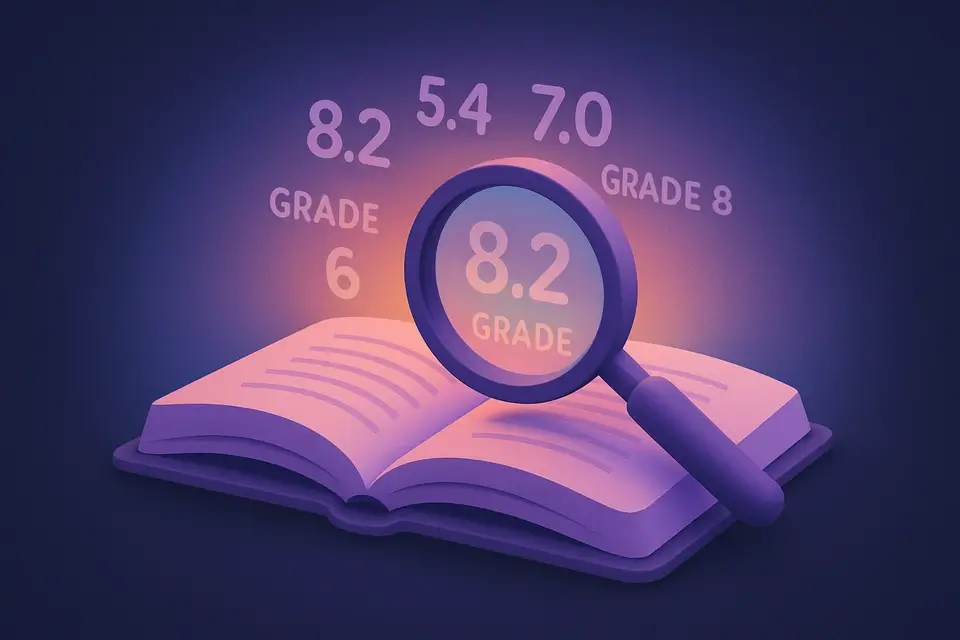
Flesch-Kincaid Readability
Calculate Flesch-Kincaid readability score and grade level for any text.
Paste Your Text
Copy and paste your text, article, or document into the input area.
Get Readability Scores
Instantly see the Flesch Reading Ease score (0-100) and Flesch-Kincaid Grade Level.
Optimize Your Writing
Use the detailed statistics and score scale to simplify text for your target audience.
What Is Flesch-Kincaid Readability?
The Flesch-Kincaid Readability Calculator measures how easy or difficult your text is to read using two scientifically validated formulas developed by Rudolf Flesch and J. Peter Kincaid. The Flesch Reading Ease score rates text on a 0-100 scale where higher scores mean easier reading, with 60-70 being ideal for general audiences. The Flesch-Kincaid Grade Level converts the same analysis into a U.S. school grade level. Both formulas analyze sentence length (words per sentence) and word complexity (syllables per word). Originally developed for the U.S. Navy to assess technical manual readability, these formulas are now the most widely used readability metrics in the world, adopted by educators, content marketers, healthcare communicators, legal professionals, and UX writers. Most style guides recommend targeting a Flesch score of 60+ for public-facing content.
Why Use Flesch-Kincaid Readability?
-
Get both Flesch Reading Ease and Grade Level scores in one analysis
-
See detailed text statistics including words, sentences, syllables, and averages
-
Reference the built-in score scale to understand what your score means
-
Runs entirely in your browser with no data sent anywhere
-
Used by content teams at major publications to ensure accessibility
Common Use Cases
Content Marketing
Ensure blog posts and web copy score 60+ for maximum reader engagement and lower bounce rates.
Healthcare Communication
Verify patient-facing materials meet AMA recommendations of 6th-8th grade reading level.
Education
Match instructional materials to student reading levels for optimal learning outcomes.
Legal & Compliance
Check that disclosures and regulatory documents meet plain language requirements.
UX Writing
Test interface copy and error messages for clarity across diverse user bases.
Technical Guide
The Flesch Reading Ease formula is: 206.835 - 1.015 * (words/sentences) - 84.6 * (syllables/words), clamped between 0 and 100. The Flesch-Kincaid Grade Level formula is: 0.39 * (words/sentences) + 11.8 * (syllables/words) - 15.59. Syllable counting uses a heuristic: strip non-alphabetic characters, handle silent-e endings, collapse consecutive vowel groups, and count vowel clusters (a,e,i,o,u,y). While not 100% accurate for every word, the heuristic is consistent with the original formula calibration. Sentences are split on terminal punctuation (.!?). For best accuracy, input at least 100 words of running prose. The tool displays detailed statistics including average words per sentence and syllables per word, the two raw formula inputs.
Tips & Best Practices
-
1Aim for a Flesch Reading Ease score of 60-70 for general web content
-
2Shorten sentences first for the biggest impact on score
-
3Replace long words with shorter synonyms: "utilize" to "use", "approximately" to "about"
-
4A grade level of 8 or below ensures 85% of U.S. adults can understand your text
-
5Test multiple paragraphs since readability varies throughout a document
Related Tools


Gunning Fog Index
Calculate the Gunning Fog readability index to measure text complexity.
✍️ Writing Tools
Coleman-Liau Index
Calculate the Coleman-Liau readability index using character-based analysis.
✍️ Writing Tools

SMOG Index
Calculate the SMOG readability index for healthcare and public documents.
✍️ Writing Tools
Reading Level Analyzer
Comprehensive readability analysis using all major formulas in one report.
✍️ Writing Tools

Sentence Length Analyzer
Analyze sentence length distribution for better rhythm and readability.
✍️ Writing ToolsFrequently Asked Questions
Q What is a good Flesch-Kincaid score?
Q How accurate is the syllable counting?
Q How many words do I need?
Q What is the difference between Reading Ease and Grade Level?
Q Does this work for non-English?
Q Why is my academic paper scoring low?
About This Tool
Flesch-Kincaid Readability is a free online tool by FreeToolkit.ai. All processing happens directly in your browser — your data never leaves your device. No registration or installation required.