Convert Between Celsius, Fahrenheit, Kelvin & Rankine Convert between Celsius, Fahrenheit, Kelvin, and Rankine temperature scales with real-time results.
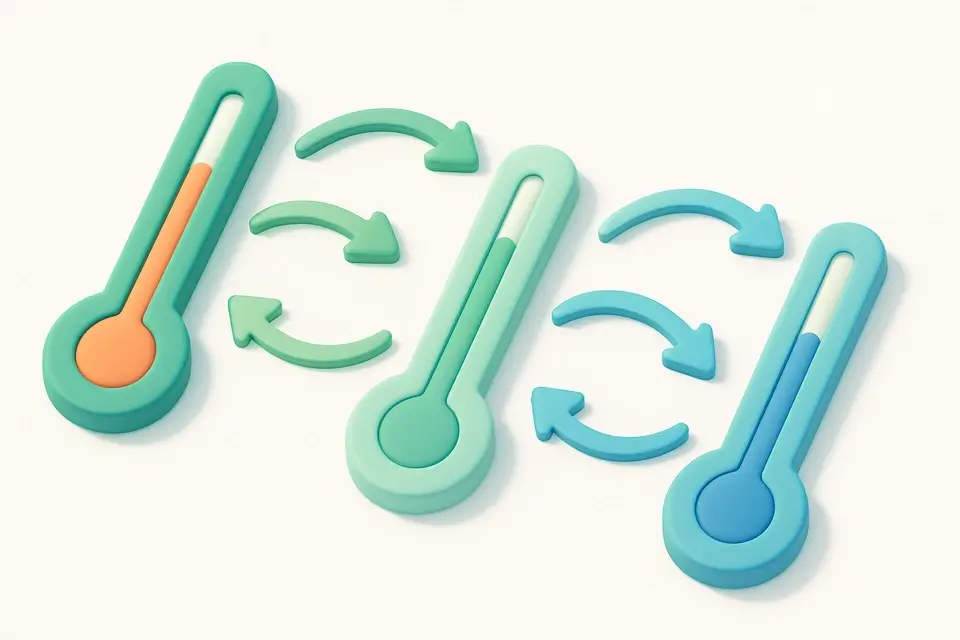
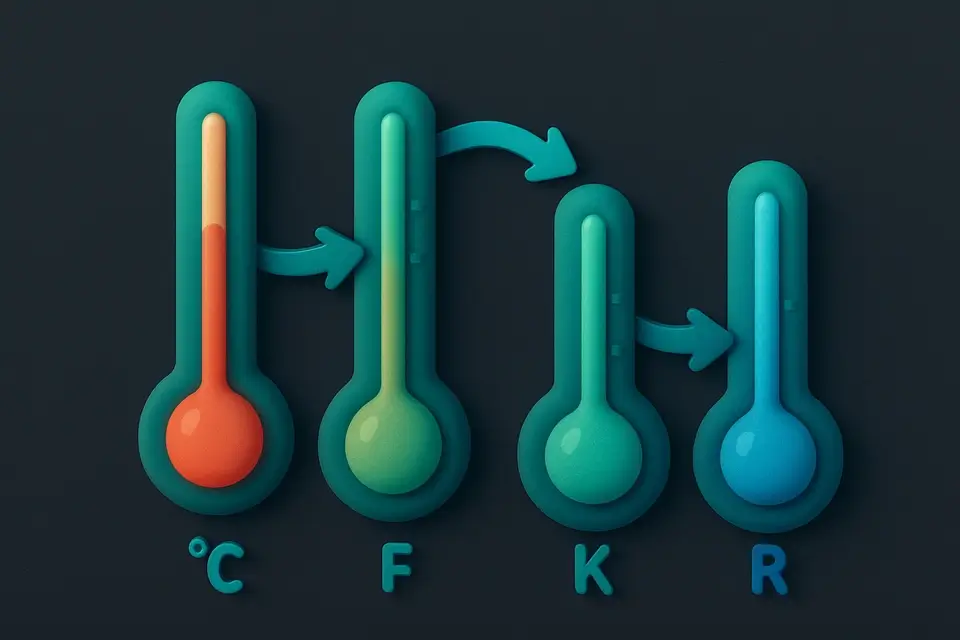
Temperature Converter
Convert between Celsius, Fahrenheit, Kelvin, and Rankine temperature scales with real-time results.
Enter a temperature
Type the temperature value you want to convert.
Select scales
Choose the source scale (e.g., Celsius) and the target scale (e.g., Fahrenheit).
Read the converted temperature
The converted temperature updates instantly. Use the reference table for common values.
What Is Temperature Converter?
A temperature converter translates values between the four major temperature scales: Celsius, Fahrenheit, Kelvin, and Rankine. Unlike most unit conversions which use simple multiplication, temperature conversions require both scaling and offsetting because the scales have different zero points. Celsius (°C) sets 0° at the freezing point of water and 100° at its boiling point at standard pressure. Fahrenheit (°F) sets 32° at water's freezing point and 212° at its boiling point. Kelvin (K) is the SI thermodynamic temperature scale starting at absolute zero (−273.15°C), with degree intervals identical to Celsius. Rankine (°R) also starts at absolute zero but uses Fahrenheit-sized degrees. This converter handles all four scales with exact conversion formulas, providing immediate bidirectional conversion as you type.
Why Use Temperature Converter?
-
Handles all four major temperature scales including Rankine.
-
Real-time bidirectional conversion as you type.
-
Uses exact conversion formulas, not approximations.
-
Quick reference table with common temperature values.
-
Essential for science, cooking, HVAC, and international travel.
-
No server required — pure client-side calculation.
Common Use Cases
Cooking
Convert oven temperatures between Celsius and Fahrenheit for international recipes.
Weather
Understand weather forecasts from other countries by converting between °C and °F.
Science & Engineering
Translate between Kelvin for thermodynamics and Celsius/Fahrenheit for practical measurements.
HVAC & Industry
Verify temperature specifications across different standards and documentation systems.
Technical Guide
Temperature conversion differs fundamentally from most unit conversions because temperature scales have different zero points (offsets). The conversion formulas are:
• Celsius to Fahrenheit: °F = °C × 9/5 + 32
• Fahrenheit to Celsius: °C = (°F − 32) × 5/9
• Celsius to Kelvin: K = °C + 273.15
• Kelvin to Rankine: °R = K × 9/5
Our converter uses Kelvin as the internal base unit. Each temperature scale defines two functions: toBase (converting to Kelvin) and fromBase (converting from Kelvin). This approach correctly handles the non-linear offset between scales.
Absolute zero (0 K = −273.15°C = −459.67°F = 0°R) is the lowest possible temperature, where all molecular motion ceases in classical thermodynamics. Negative Kelvin temperatures are not meaningful in classical physics but can arise in certain quantum systems.
The Celsius and Kelvin scales have identical degree sizes; the only difference is the zero point. Similarly, Fahrenheit and Rankine degrees are the same size but differ in zero point. A change of 1°C equals a change of 1.8°F.
Tips & Best Practices
-
1Quick mental math: double °C and add 30 for a rough °F estimate (exact at 10°C = 50°F).
-
2Body temperature: 37°C = 98.6°F. Room temperature: about 20-22°C = 68-72°F.
-
3For science, Kelvin is preferred because it has no negative values and ratios are meaningful.
-
4The only temperature where °C = °F is −40° (both scales intersect at this point).
-
5Rankine is rarely used outside of some US engineering applications involving thermodynamics.
Related Tools

Speed Converter
Convert between m/s, km/h, mph, knots, ft/s, and Mach numbers instantly.
⚖️ Unit Converters
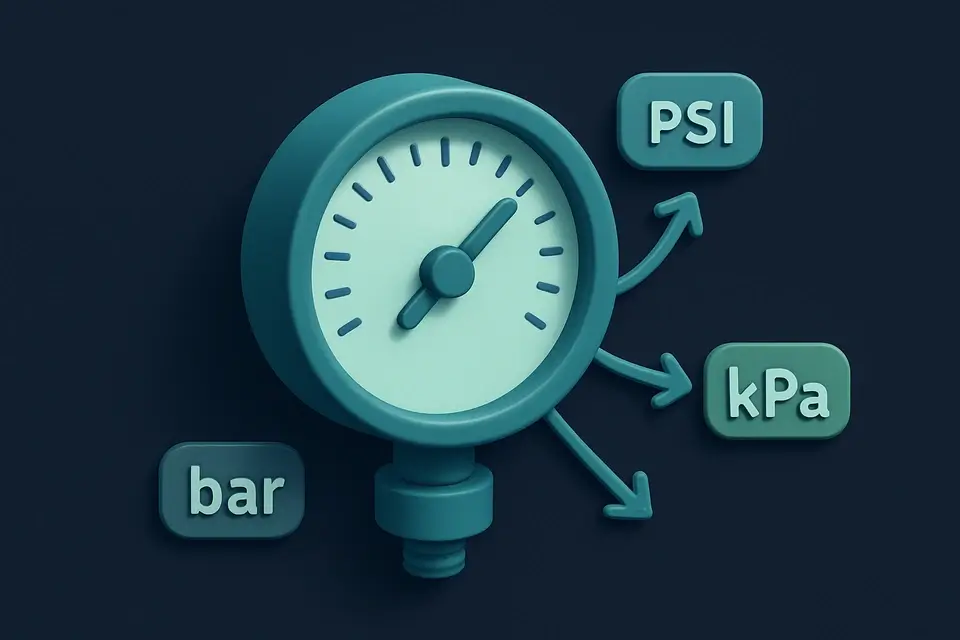
Pressure Converter
Convert between Pascal, kilopascal, bar, atmosphere, PSI, mmHg, and Torr pressure units.
⚖️ Unit Converters
Energy Converter
Convert between joules, kilojoules, calories, kilocalories, watt-hours, kilowatt-hours, BTU, and electronvolts.
⚖️ Unit Converters
Power Converter
Convert between watts, kilowatts, megawatts, horsepower, PS, BTU/h, and ft-lbf/s.
⚖️ Unit ConvertersFrequently Asked Questions
Q What is the formula for Celsius to Fahrenheit?
Q What is absolute zero?
Q Why are there different temperature scales?
Q What temperature is the same in both Celsius and Fahrenheit?
Q What is the Rankine scale used for?
About This Tool
Temperature Converter is a free online tool by FreeToolkit.ai. All processing happens directly in your browser — your data never leaves your device. No registration or installation required.