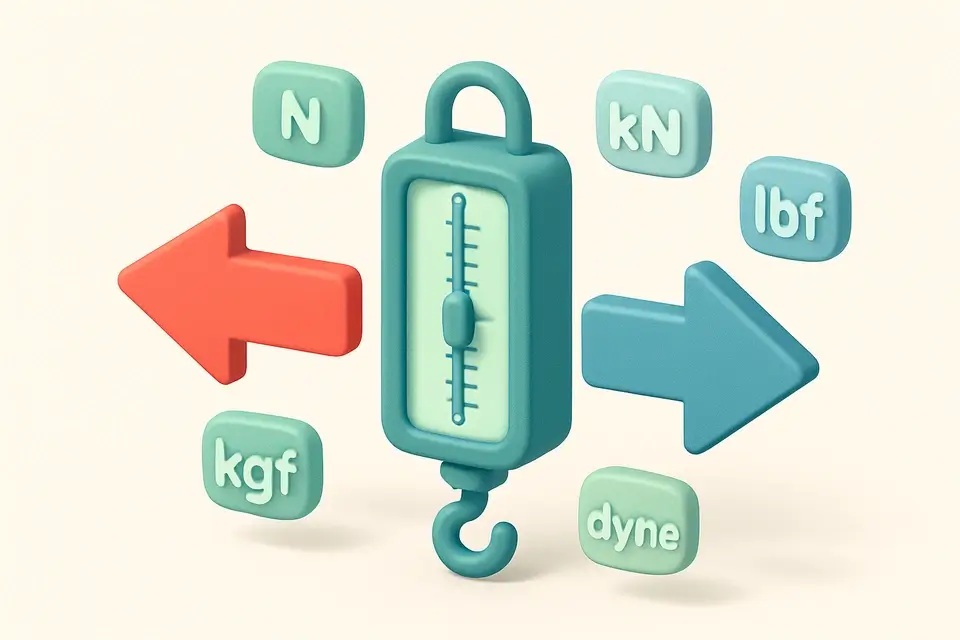
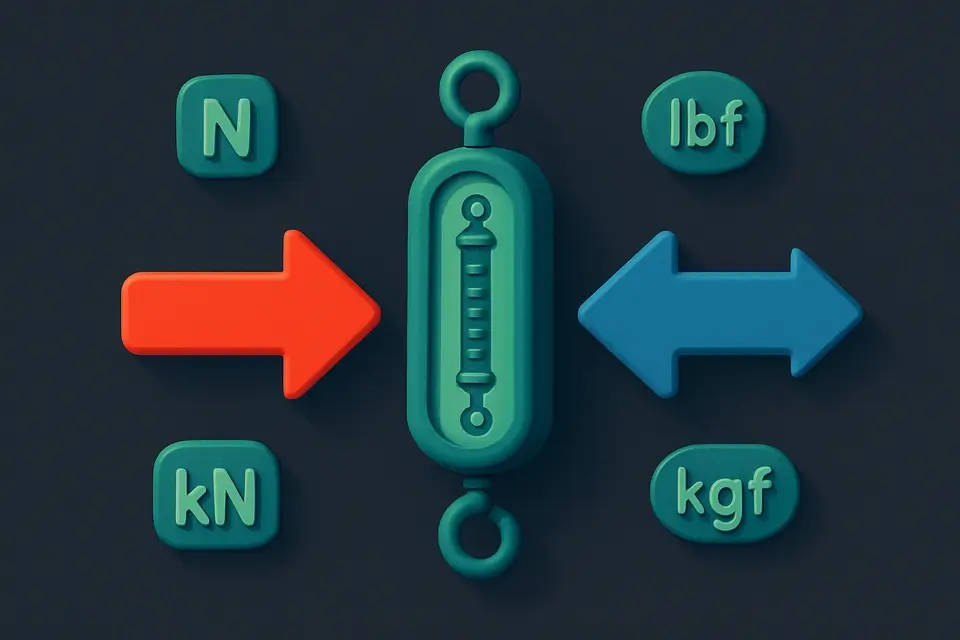
Force Converter Convert between newtons, kilonewtons, pound-force, kilogram-force, dynes, and poundals.
Force Converter
Convert between newtons, kilonewtons, pound-force, kilogram-force, dynes, and poundals.
Enter force value
Type the force measurement to convert.
Select units
Choose source and target force units.
View the converted force
Converted force appears instantly.
What Is Force Converter?
A force converter translates between different units of force — the push or pull that causes acceleration. The newton (N) is the SI unit, defined as the force needed to accelerate 1 kg at 1 m/s². Kilogram-force (kgf) represents the gravitational force on 1 kg at standard gravity. Pound-force (lbf) is the imperial equivalent. Dynes (CGS system) and poundals (imperial absolute) are older units still found in some physics texts. This converter is essential for engineering, physics, and any application involving mechanical forces.
Why Use Force Converter?
-
Covers SI (N, kN), gravitational (kgf, lbf), and CGS (dyne) force units.
-
Essential for physics and mechanical engineering.
-
Uses exact conversion factors.
-
Real-time bidirectional conversion.
Common Use Cases
Mechanical Engineering
Convert force specifications between metric and imperial systems.
Physics Education
Work with force problems across different unit systems.
Material Testing
Express tensile strength and load measurements in the required force unit.
Aerospace
Translate thrust ratings between newtons and pound-force for propulsion analysis.
Technical Guide
Force = mass × acceleration (F = ma). The newton is defined as:
1 N = 1 kg × 1 m/s²
Key conversions:
• 1 kN = 1,000 N
• 1 kgf = 9.80665 N (using standard gravity g₀ = 9.80665 m/s²)
• 1 lbf = 4.44822 N
• 1 dyne = 10⁻⁵ N (CGS unit)
• 1 poundal = 0.13825 N (the force that accelerates 1 lb at 1 ft/s²)
The distinction between mass and force is critical: a kilogram is a unit of mass, while a kilogram-force is a unit of force. In everyday speech, "weight" usually means force (gravitational), but the kilogram on your scale is technically measuring mass. The kgf exists to bridge this conceptual gap.
Tips & Best Practices
-
11 kgf ≈ 9.81 N (the weight of 1 kg on Earth's surface).
-
21 lbf ≈ 4.45 N. To convert quickly, multiply pounds-force by 4.45.
-
3Rocket thrust is often given in kN or lbf. SpaceX Merlin engine: ~845 kN = ~190,000 lbf.
-
4The dyne is tiny: 1 N = 100,000 dynes.
Related Tools


Weight Converter
Convert between milligrams, grams, kilograms, ounces, pounds, metric tons, and stones in real time.
⚖️ Unit Converters

Pressure Converter
Convert between Pascal, kilopascal, bar, atmosphere, PSI, mmHg, and Torr pressure units.
⚖️ Unit Converters
Energy Converter
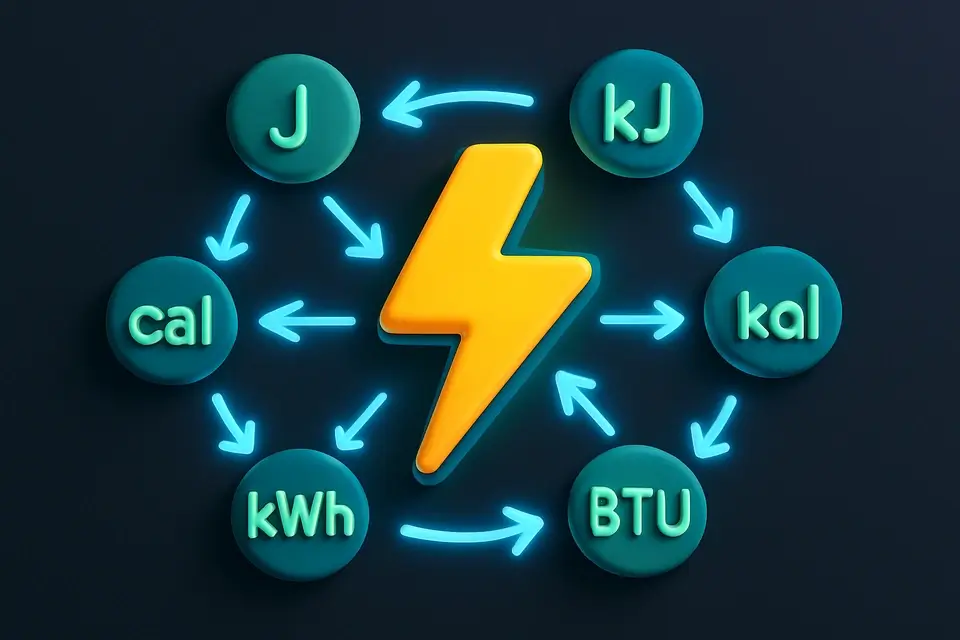
Convert between joules, kilojoules, calories, kilocalories, watt-hours, kilowatt-hours, BTU, and electronvolts.
⚖️ Unit Converters

Torque Converter
Convert between newton-meters, foot-pounds, inch-pounds, and kilogram-force meters.
⚖️ Unit ConvertersFrequently Asked Questions
Q How many newtons is one pound-force?
Q What is the difference between kgf and kg?
Q What is a dyne?
Q What is a poundal?
Q How do I convert lbf to kgf?
About This Tool
Force Converter is a free online tool by FreeToolkit.ai. All processing happens directly in your browser — your data never leaves your device. No registration or installation required.