Convert Between Data Storage Units Convert between bits, bytes, KB, MB, GB, TB, PB in both binary (IEC) and decimal (SI) standards.
Data Storage Converter
Convert between bits, bytes, KB, MB, GB, TB, PB in both binary (IEC) and decimal (SI) standards.
Enter a storage value
Type the data storage value to convert.
Select units
Choose between SI (KB, MB) and IEC (KiB, MiB) units.
View the converted values
Converted value appears instantly with full precision.
What Is Data Storage Converter?
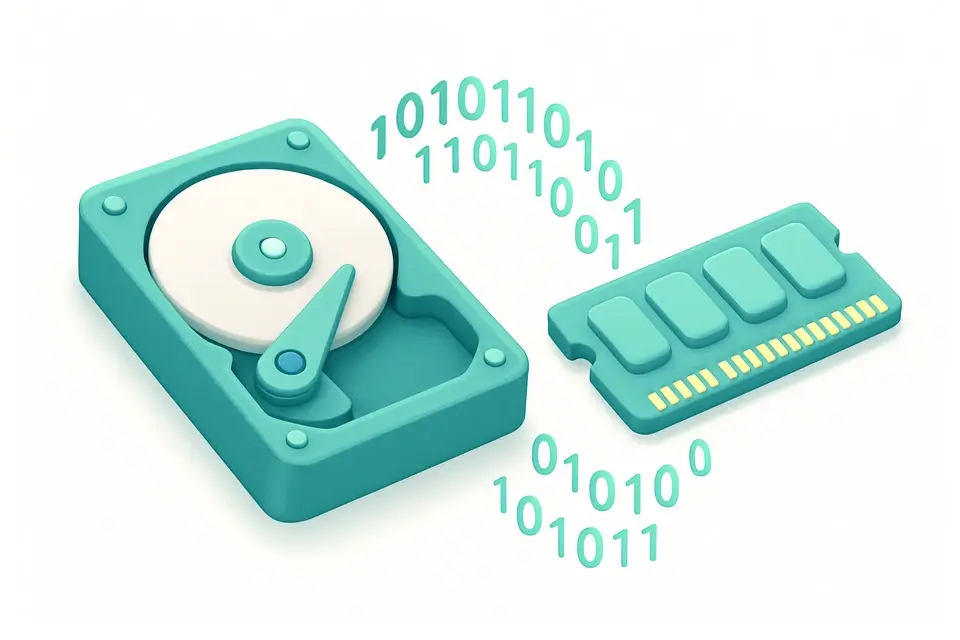
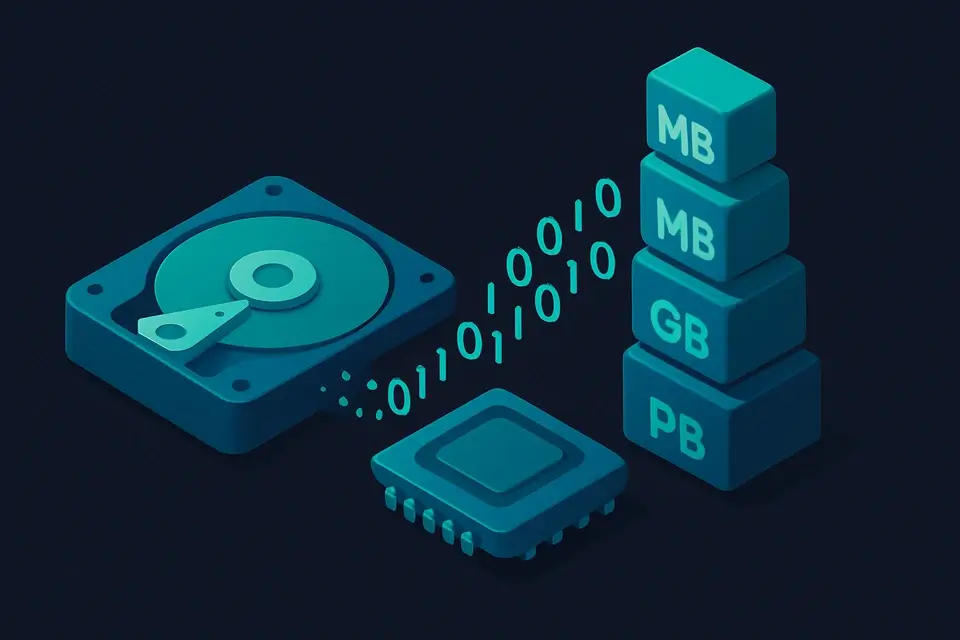
A data storage converter translates between units of digital information. The fundamental units are bits and bytes (1 byte = 8 bits). Larger units come in two standards: decimal (SI) using powers of 1,000 (KB, MB, GB, TB, PB) and binary (IEC) using powers of 1,024 (KiB, MiB, GiB, TiB, PiB). This distinction matters because operating systems and hard drive manufacturers use different standards, leading to the common confusion where a "500 GB" drive shows as "465 GiB" in your file manager. Our converter supports both standards, helping you understand exactly how much storage you are working with.
Why Use Data Storage Converter?
-
Supports both decimal (SI) and binary (IEC) storage units.
-
Explains the difference between GB and GiB that confuses many users.
-
Essential for IT professionals and anyone buying storage.
-
Covers the full range from bits to petabytes.
-
Real-time bidirectional conversion.
Common Use Cases
IT & System Administration
Convert between binary and decimal storage units for accurate disk provisioning.
Buying Storage
Understand why your "1 TB" hard drive shows less space than expected in your OS.
Networking
Switch between bits and bytes to accurately calculate network bandwidth.
Programming
Calculate memory requirements and buffer sizes in bytes, KB, and MB.
Technical Guide
Digital storage has two competing standards for unit prefixes:
Decimal (SI) - based on powers of 1,000:
• 1 KB = 1,000 bytes
• 1 MB = 1,000,000 bytes
• 1 GB = 1,000,000,000 bytes
• 1 TB = 10¹² bytes
• 1 PB = 10¹⁵ bytes
Binary (IEC) - based on powers of 1,024:
• 1 KiB = 1,024 bytes
• 1 MiB = 1,048,576 bytes
• 1 GiB = 1,073,741,824 bytes
• 1 TiB = 2⁴⁰ bytes
• 1 PiB = 2⁵⁰ bytes
The discrepancy grows with scale:
• 1 KB vs 1 KiB: 2.4% difference
• 1 GB vs 1 GiB: 7.4% difference
• 1 TB vs 1 TiB: 10% difference
Hard drive manufacturers use SI units (making drives appear larger), while operating systems like Windows traditionally display binary units. macOS switched to SI units in 2009.
Tips & Best Practices
-
1Your "1 TB" hard drive = 1,000 GB (SI) = 931 GiB (binary). That's why the OS shows less.
-
21 byte = 8 bits. Internet speeds are in bits/s; file sizes are in bytes.
-
3RAM is always measured in binary: 8 GB RAM = 8 GiB = 8,589,934,592 bytes.
-
4For quick binary math: 2¹⁰ = 1,024 ≈ 1,000. Each power of 1,024 diverges further from the SI equivalent.
Related Tools

Frequency Converter
Convert between Hertz, kilohertz, megahertz, gigahertz, and RPM.
⚖️ Unit Converters

Data Transfer Rate Converter
Convert between bps, Kbps, Mbps, Gbps, B/s, KB/s, and MB/s data transfer speeds.
⚖️ Unit Converters
Time Converter
Convert between milliseconds, seconds, minutes, hours, days, weeks, months, and years.
⚖️ Unit Converters

CSS Units Converter
Convert between px, em, rem, %, vw, vh, vmin, and vmax with configurable viewport and font size.
⚖️ Unit ConvertersFrequently Asked Questions
Q What is the difference between GB and GiB?
Q Why does my hard drive show less space than advertised?
Q How many bytes in a megabyte?
Q Is RAM measured in GB or GiB?
Q How many bits in a byte?
About This Tool
Data Storage Converter is a free online tool by FreeToolkit.ai. All processing happens directly in your browser — your data never leaves your device. No registration or installation required.