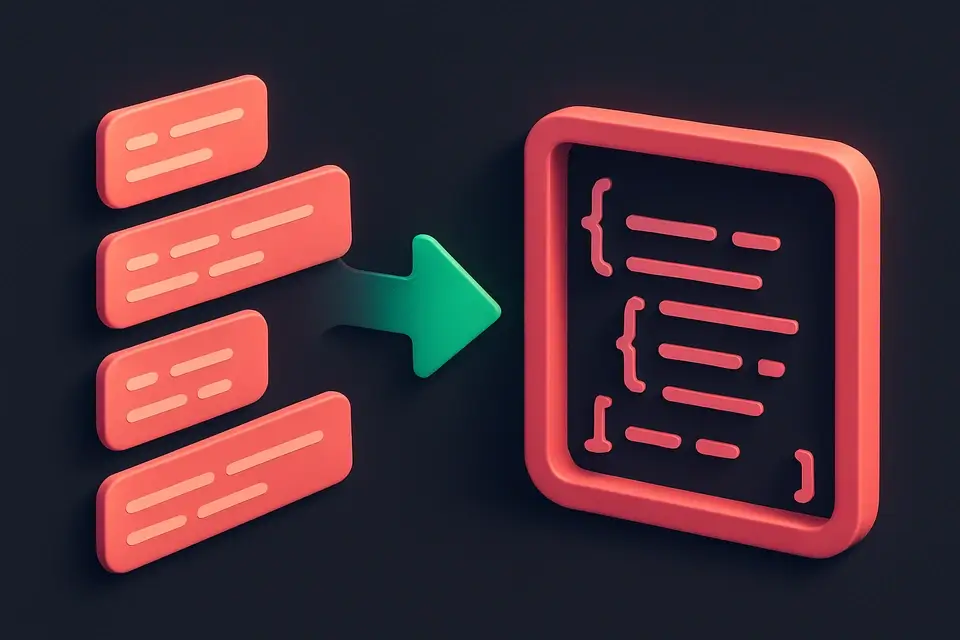
Convert JSONL to JSON Array Convert JSON Lines (JSONL) format back to a standard JSON array.

JSON Lines to JSON
Convert JSON Lines (JSONL) format back to a standard JSON array.
Paste JSONL data
Paste JSON Lines data (one JSON value per line).
View JSON array
The output is a formatted JSON array containing all lines.
Copy JSON array
Copy the JSON array for use in applications.
What Is JSON Lines to JSON?
A JSON Lines to JSON converter transforms newline-delimited JSON data into a standard JSON array format. Developers working with large datasets or log files often use it to reformat their data for easier processing or analysis. One specific problem this tool solves is handling invalid JSON lines in the input, which can cause parsing errors and make it difficult to identify the source of the issue.
The code behind the tool uses a `try-catch` block to catch any parsing errors that occur when attempting to parse each line as JSON. If an error occurs, it throws a new error with a message indicating the specific line number where the error occurred. This feature makes it easier for users to identify and fix issues in their input data.
What sets this tool apart is its ability to filter out empty lines from the input and format the output array with proper indentation, using two spaces as specified by the `JSON.stringify` function's third argument. When converting JSONL to JSON or ndjson to json, it uses a `map` function to apply the JSON parsing logic to each line, resulting in an array of parsed JSON objects that can be easily converted back into a standard JSON string. It also provides an input placeholder with sample data, including two JSON lines, demonstrating how to use the tool for converting jsonl to json.
Why Use JSON Lines to JSON?
-
Parses each line independently with line-number error reporting.
-
Produces formatted JSON array with 2-space indentation.
-
Handles any JSON value type per line, not just objects.
-
Instant conversion with clear error messages.
Common Use Cases
Data Analysis
Convert JSONL log files or data exports into a JSON array for analysis tools.
API Payloads
For API testing, transform JSONL data into JSON arrays for requests.
Debugging
Convert JSONL streaming data into a readable JSON array for debugging.
Data Migration
For data migration, convert JSONL exports from BigQuery or similar services into standard JSON.
Technical Guide
The tool works by first splitting the input into lines using the `trim()` and `split('\n')` methods, then filtering out empty lines with `filter(l => l.trim())`. This ensures that only non-empty lines are processed further. Each line is then parsed as JSON using `JSON.parse()`, which throws an error if the line is not valid JSON. The `try-catch` block catches these errors and re-throws them with a message indicating the specific line number where the error occurred, allowing users to identify and fix issues in their input data.
The parsed JSON values are collected into an array using the `map()` function, which applies the parsing logic to each line. The resulting array of JSON objects is then serialized as a formatted JSON string using `JSON.stringify()`, with two spaces used for indentation as specified by the third argument `null, 2`. This produces a standard JSON array format that can be easily processed or analyzed further. The React library's `useCallback` hook is used to memoize the processing function, ensuring it doesn't get recreated unnecessarily.
The tool uses TextToolLayout component from the `@/components/shared` module, which provides input and output labels, as well as an input placeholder with sample data in JSON Lines format, demonstrating how to use the tool for converting jsonl to json. When a user inputs their own JSON Lines data, it gets processed by the `onProcess` function, which is called whenever the input changes, allowing users to see the converted JSON array output immediately. The serialized JSON string is then displayed as the output, with proper indentation and formatting.
Tips & Best Practices
-
1Each non-empty line must be valid JSON — invalid lines produce error messages with line numbers.
-
2Empty lines are silently skipped.
-
3The output is formatted with 2-space indentation for readability.
-
4This is the inverse of JSON to JSON Lines — perfect for round-trip conversions.
Related Tools


CSV to JSON
Convert CSV data to JSON array format instantly in your browser.
🔄 File Conversion
YAML to JSON
Convert YAML to formatted JSON with configurable indentation.
🔄 File Conversion

JSON Lines Viewer
View JSONL (JSON Lines) data as a formatted, sortable table.
🔄 File Conversion

JSON to JSON Lines
Convert a JSON array into JSON Lines (JSONL) format — one object per line.
🔄 File ConversionFrequently Asked Questions
Q What if a line has invalid JSON?
Q Are empty lines handled?
Q Can lines contain different JSON types?
Q Is the output formatted?
Q Can I convert back to JSONL?
About This Tool
JSON Lines to JSON is a free online tool by FreeToolkit.ai. All processing happens directly in your browser — your data never leaves your device. No registration or installation required.